
Berkshire Hathaway’s 2025 annual letter was penned, for the first time, by Berkshire’s new CEO, Greg Abel rather than Warren Buffett. At WMK, we view this transition as a significant case study in the exact principles that drive our own Strategic Equities Portfolio.
There is sadness in seeing Buffett step away. The education he has provided through his pragmatic writings and thoughtful explanations of investment decisions will never be replicated. He set the gold standard for public company stewardship and partnership. While Buffett remains Chairman of Berkshire, he has appropriately passed the torch of day-to-day operations in a transition so smooth that only Buffett could have accomplished it.
I will miss reading new insights from Buffett, but the lessons he has shared over decades are timeless. There is also excitement in reviewing a fresh perspective on a great American business like Berkshire. While Greg is no stranger to Berkshire, he was not the architect of the conglomerate, which lets him provide differentiated insights on the business.
Greg’s letter provided an excellent framework for how Berkshire’s leadership thinks about the culture and values of their company. For the WMK team, it was as clear of an overview of a high-quality compounding machine as I have read.
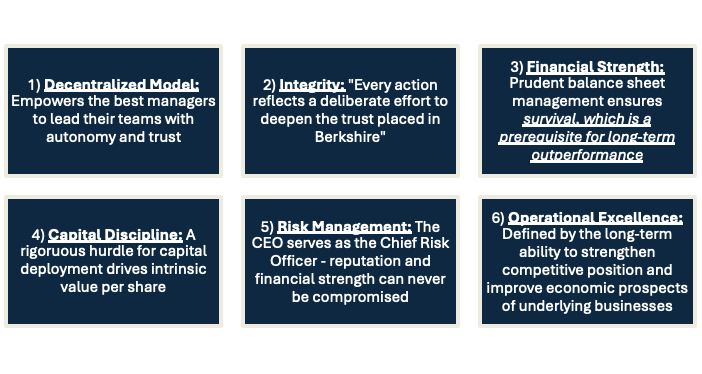
Six Pillars of Cultural Investment Due Diligence
As investors, we should take note of this framework as it has driven a company that has compounded at an annual rate of 19.7% since 1965 vs. 10.5% for the S&P 500. Greg characterizes Berkshire’s culture as one of Partnership, which rings true to Buffett’s approach for decades. Greg’s overview of the six values underpinning Berkshire’s decisions, which closely mirror the WMK due diligence filter, are as follows:
Bridging the Berkshire Model to WMK’s Process
The simplicity of Greg’s message is brilliant. It is also a surprisingly similar filter to how WMK reviews a company during investment due diligence. These six pillars are essential in every great business, though we often see them manifest in different operational structures.
Decentralization: Empowering Culture to Drive Performance
Not every great business appears to be as decentralized as Berkshire. However, they all share a commonality that talented people are emboldened to do their best work. WMK believes that culture helps drive performance over time, and people drive culture (for better or for worse!). Within WMK’s Strategic Equities Portfolio, we would highlight Alimentation Couche-Tard (convenience store operator) as a business that enables local operators to make real-time decisions.
Capital Discipline: Identifying Proven Acquirers for Long-Term Growth
Greg’s discussion of capital discipline is excellent. WMK would add that a great business must have the ability for continual long-term growth in a capital efficient manner. Berkshire has accomplished this by finding new businesses to invest in on top of reinvesting in current holdings. In most cases, WMK searches for businesses that can allocate capital internally or are proven acquirers for external growth. Loar Holdings is one such example from WMK’s Strategic Equities Portfolio as they search for aerospace parts providers that have assets with a useful lives that might reach 50 years while also having the ability to acquire new businesses on a regular basis.
Building Durable Performance Through Investment Due Diligence
Though Buffett’s departure from authorship marks the end of an era, Greg Abel’s inaugural letter demonstrates that Berkshire’s culture and values remain as strong as ever. His emphasis on partnership, discipline, and long-term thinking reinforces the qualities that have defined Berkshire’s success for decades. For investors and business leaders alike, the letter is a timely reminder that durable performance is built on culture, clarity, and an unwavering commitment to doing the right things well.
Disclosures:
Investment advisory services are offered through WMKI Group LLC dba WMK Investment Partners, a Registered Investment Adviser. The views expressed represent the opinion of WMKI Group LLC. The views are subject to change and are not intended as a forecast or guarantee of future results. This material is for informational purposes only. It does not constitute investment advice and is not intended as an endorsement of any specific investment. Stated information is derived from proprietary and nonproprietary sources that have not been independently verified for accuracy or completeness. While WMKI Group LLC believes the information to be accurate and reliable, we do not claim or have responsibility for its completeness, accuracy, or reliability. Statements of future expectations, estimates, projections, and other forward-looking statements are based on available information and the WMKI Group LLC’s view as of the time of these statements. Accordingly, such statements are inherently speculative as they are based on assumptions that may involve known and unknown risks and uncertainties. Actual results, performance or events may differ materially from those expressed or implied in such statements. Investing in equity securities involves risks, including the potential loss of principal. While equities may offer the potential for greater long-term growth than most debt securities, they generally have higher volatility. International investments may involve risk of capital loss from unfavorable fluctuation in currency values, from differences in generally accepted accounting principles, or from economic or political instability in other nations.