
Following a weak Q1, market indices rallied in Q2 with the ACWI rising 15% in the quarter. The makeup was extraordinary: Semiconductors returned 58.5% and Server Hardware/Power an estimated ~30%. Those two buckets contributed ~10-11% of the index’s 15%, leaving ~4.5% for the rest of the global economy.
Only ~25% of ACWI constituents outperformed the index. That echoes the 1998-99 dot-com buildout, when ~28% outperformed. In a normal year, 50-52% do.
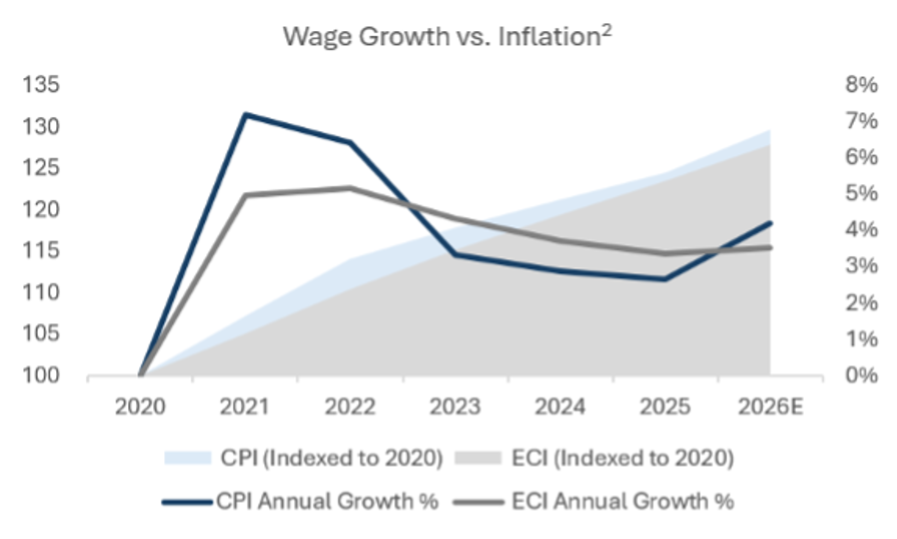
This divergence is at least in part due to continued pressure on consumers where inflation has outpaced wage growth. 2026 will not be a reprieve as inflation is expected to run 4.6% globally, driven in part by the oil and gas supply shock from conflict in the Middle East.1 Households are financially stressed, and the middle and lower class will absorb most of the strain.
AI infrastructure spend is projected to reach ~$1 trillion in 2026, with companies guiding higher for 2027. That is material against the ~3.0% global growth the IMF projects for 2026: CBA, a global investment bank, estimates AI capex alone will drive ~1% of world GDP.3
We take no stance on whether AI is good for the world. The technology is revolutionary and the productivity opportunity is real. But productivity gains have not yet shown up in the data. The dot-com parallel is hard to ignore: capex took 5-10 years to be absorbed before it produced real economic benefits. AI may deliver sooner. But overbuilding capacity for a handful of models is not so different from the buildout of fiber and other hardware, which saw severe pullbacks when profits did not quickly follow capex. Cisco fell ~88% from its peak. It built real products and created real value, but no valuation metric survives capex going from booming to minimal.
We are not calling a 1999-style bubble. Today’s AI beneficiaries are largely cash-generative businesses with revenue lines beyond AI, especially cloud providers like Google, Microsoft, and Amazon. But forecasting flat-to-higher demand for chip and memory makers like Nvidia requires their customers to see the benefit in their own financials.
The potential for productivity gains and margin improvement is material across the universe of businesses we monitor. Those that learn to harness AI for real productivity — not just activity — will accelerate their lead vs. competitors. In our own business, AI has helped our people see more, analyze deeper, and surface information faster. We are hopeful AI drives real productivity growth, because that will drive long-term cash generation in businesses.
Strategic Equities
WMK’s direct equity strategy was unusually active during Q2.
We exited Callaway Golf, up ~36% in the quarter, where our thesis was that the market undervalued Topgolf. Callaway then sold a 60% stake in Topgolf at a $1.1B valuation, leaving limited remaining upside, so we used the quarter’s strength to exit.
We also trimmed our position in Perimeter Solutions (PRM), which returned ~38% in the quarter. Partners invested since we first bought Perimeter — a fire-retardant business with exceptional leadership — have more than doubled their money. We remain encouraged by the long-term opportunity but wanted to bank some gains for redeployment into more attractive opportunities today.
We added three quality businesses to our conglomerate, each weak year-to-date for its own reasons: Microsoft (-20% YTD), Copart (-27% YTD) and Roper Technologies (-20% YTD).
Each has a durable moat, strong leadership, and a reasonable price. Summaries below.
- Roper Technologies: Founded in 1890 as an industrial manufacturer, Roper is now a high-margin vertical software conglomerate. Roper traded at ~28x earnings over the last five years on the strength of its recurring revenues. AI-disintermediation fears have since pushed shares to ~15x. We think that fear is misplaced — AI should let Roper add more value to its customers, not less — and management has implemented an internal AI Accelerator to deploy agentic workflows for customers. Management agrees and has responded to market weakness by repurchasing ~$3.2B of shares between Q4 2025 and Q2 2026. In Roper, we bought 6%+ organic growth at a >7% FCF yield, run by a team with the capital to keep compounding it through accretive M&A or buybacks.
- Copart: Founded in 1982 by Willis Johnson, Copart is the world’s largest salvage vehicle auction, selling insurance total-losses to a global pool of bidders. The moat is hard-to-permit salvage yard real estate near population centers plus a deep buyer pool. These attributes made Copart a darling of the COVID recovery. The market now reads soft volumes as share loss in a mature end market. We think the aging car parc and a rising total-loss rate driven by the cost of repairs are underappreciated. Additionally, there is international expansion optionality and a balance sheet strong enough to fund buybacks, Copart was a valuable add to our conglomerate.
- Microsoft: Microsoft needs no introduction. We have never owned the business due to valuation with Microsoft trading at >30x earnings for most of the last five years. Its AI strategy is clear-eyed: capture cloud demand now, and over time let customers run whichever model is cheapest so long as the work happens inside the Microsoft ecosystem. The risk in Microsoft is that the cloud revenue does not materialize to support the significant capex. This risk is real but is likely the most defensible layer of the AI stack.
Required Reserves
Many of WMK’s Partners — including our Founder — own reinsurance entities that carry a benchmark of 90% investment grade fixed income (AGG) and 10% S&P 500 (SPY). We invest it with the same discipline as the equity portfolio: avoid unnecessary risk, build in structural resilience.
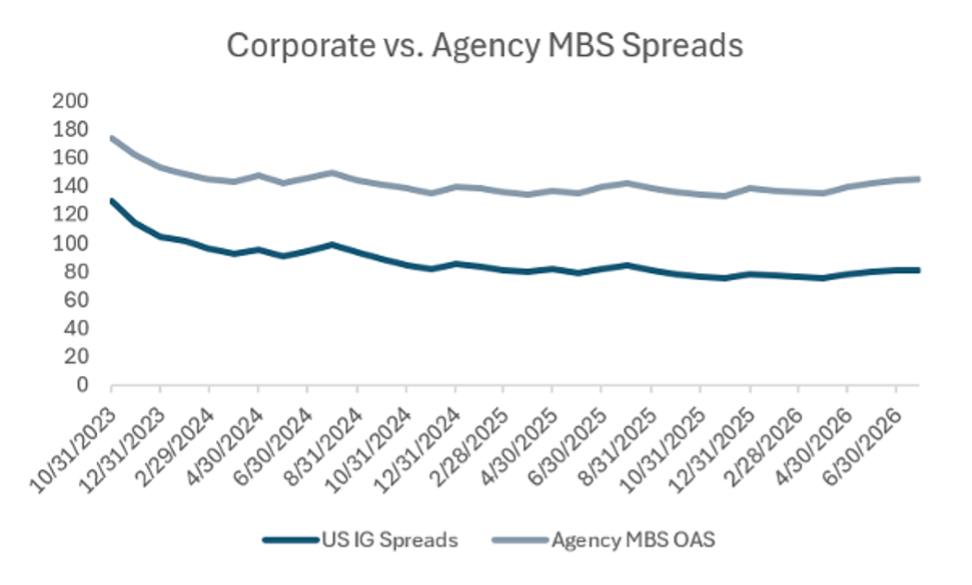
In our Q1 2026 Portfolio Review, we noted the relative value of Agency MBS vs. Investment Grade corporate credit. For those new to the strategy: we hunt for relative value across the investment grade universe — Treasuries, corporate bonds, or agency MBS. Agency MBS trades at a slight premium to historic levels (~145bps over Treasuries), while corporate bonds sit at historically tight spreads (~80bps).
Leaning into that, the core Required Reserves portfolio exited Q2 at a ~5.3% yield-to-maturity against the benchmark’s ~4.7%, with shorter duration of 5.1 vs. 5.7. More yield, less rate risk.
Closing Thoughts
WMK’s goal is to intelligently allocate capital to the best long-term opportunities over time. In a period where a quarter of the index produced the return and real wealth creation was negative, that meant selling strength and buying businesses the market had marked down 20% or more. We promise no ability to predict the future, only positions built to withstand it. Thank you for your continued trust.
Sources
- “Global Economic Outlook for Q2 2026: Growth Redefined by Energy Shock.” Aiste Bijune. June 8, 2026. https://www.euromonitor.com/article/global-economic-outlook-for-q2-2026-growth-redefined-by-energy-shock
- Data provided by St. Louis Fed, Congressional Budget Office and Trading Economics.
- “AI investment surge set to lift global economic growth and reshape trade.” CommBank. May 22, 2026. https://www.commbank.com.au/articles/newsroom/2026/05/ai-investment-to-lift-global-growth.html
Disclosures
The views expressed above are those of WMK Investment Partners. These views are subject to change at any time based on market and other conditions, and WMK disclaims any responsibility to update such views.
Past performance is not indicative of future performance. Principal value and investment return will fluctuate. There are no implied guarantees or assurances that the target returns will be achieved, or objectives will be met. Future returns may differ significantly from past returns due to many different factors. Investments involve risk and the possibility of loss of principal. The values and performance numbers represented in this report do not reflect management fees. WMK may discuss and display, charts, graphs, formulas which are not intended to be used by themselves to determine which securities to buy or sell, or when to buy or sell them. Such charts and graphs offer limited information and should not be used on their own to make investment decisions. To the extent that certain of the information contained herein has been obtained from third-party sources, such sources will be cited, and are believed to be reliable, but WMK has not independently verified the accuracy of such information.